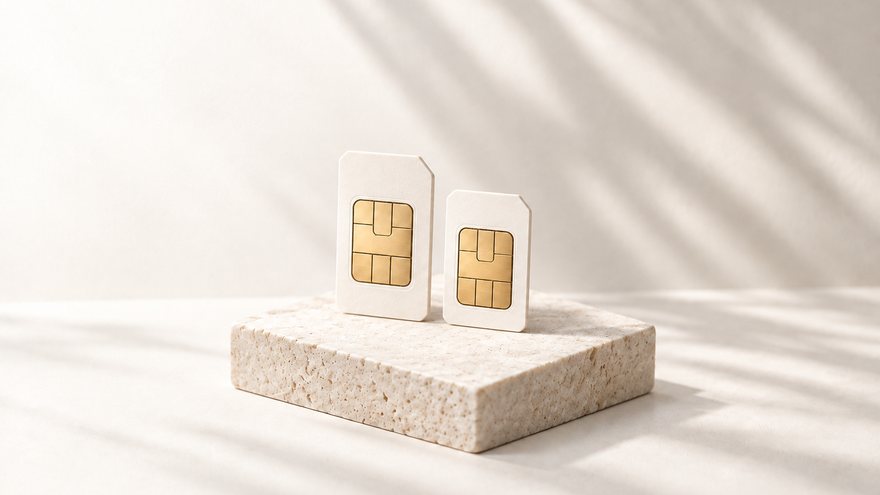
eSIM is the better choice for most people because it is easier to activate, supports multiple mobile plans, and simplifies international travel. This guide compares the two SIM types.
A SIM connects your phone to a carrier's network for calls, texts and mobile data. An eSIM is built into the phone and activated digitally. A physical SIM is a removable card that you insert into the device.
eSIM vs Physical SIM: At a Glance
| Category | eSIM | Physical SIM |
|---|---|---|
| Setup | Downloaded and activated digitally | Inserted manually |
| Switching phones | May require carrier or device transfer steps | Move the card to another compatible phone |
| International travel | Easy to add a temporary travel plan | Requires buying or obtaining another SIM |
| Multiple numbers | Can store multiple plans on supported phones | Usually one card per slot |
| Physical damage or loss | Cannot be lost or physically removed | Can be lost, damaged or misplaced |
| Compatibility | Requires an eSIM-compatible phone and carrier | Works with a wider range of older devices |
| Internet needed for setup | Usually yes | Usually no |
| Connection speed | No inherent speed advantage | No inherent speed disadvantage |
Why eSIM Is Better for Most Users
eSIM Is Easier to Activate
You can activate an eSIM through a carrier app, QR code, device settings or an automatic activation process. You do not need to wait for a SIM card, open the SIM tray or use a SIM-eject tool. Many carriers support eSIM activation over Wi-Fi.
eSIM Is More Convenient for International Travel
An eSIM lets you add a local or travel data plan while keeping your main phone number active. On phones with dual SIM support, you can use one line for calls and texts and a second line for local mobile data.
This means you can add a travel plan without removing your main SIM. The available features depend on the phone, carrier and travel plan.
eSIM Supports Multiple Mobile Plans
Many modern smartphones can store several eSIM profiles. You might use separate plans for personal calls, work and travel on the same phone. The number of stored profiles and active lines depends on the phone model, operating system and carrier.
eSIM Cannot Be Physically Removed
A physical SIM can be taken out of a lost or stolen phone. An eSIM is built into the device, so someone cannot remove it and put it directly into another phone. Google also identifies eSIMs as less vulnerable to physical damage than removable SIM cards.
That does not protect the phone or mobile account on its own. You should still use a screen lock, a strong account password and the security features offered by your carrier.
When a Physical SIM Is Better
You Regularly Switch Phones
A physical SIM is usually simpler if you often move your number between compatible phones. Remove the card from one device and insert it into another.
eSIM transfers are becoming easier, but the process varies by phone manufacturer and carrier. Apple supports several eSIM transfer methods, while transfers between iPhone and Android may still require help from the carrier.
Your Carrier Does Not Fully Support eSIM
Not every carrier, prepaid plan or regional phone model supports eSIM. Compatibility depends on the exact phone, carrier and country. A physical SIM may be the safer option when your provider offers limited eSIM support.
You Need Service Without an Internet Connection
eSIM activation usually requires Wi-Fi or another internet connection so the phone can download the carrier profile. A pre-activated physical SIM may be more convenient if you are setting up a phone somewhere without internet access.
You Use an Older Phone or Specialist Device
Older smartphones, some budget phones and certain tablets, laptops and mobile devices may only accept a physical SIM. Check the exact model before choosing an eSIM-only plan.
Does eSIM Give Better Signal or Faster Data?
No. eSIM does not automatically provide faster data, stronger signal or better 5G.
An eSIM and a physical SIM perform the same basic job. They identify your mobile plan and allow your phone to connect to the carrier network. Speed and coverage depend mainly on the carrier, plan, phone modem, supported network bands, location and network congestion.
If two identical phones use the same carrier and plan, changing from a physical SIM to an eSIM should not improve network performance by itself.
Which Should You Choose?
Choose eSIM if you:
- Have a compatible modern phone.
- Want digital activation.
- Travel internationally.
- Need personal and business numbers on one device.
- Want to add a temporary data plan without replacing your main SIM.
- Prefer not to handle a small removable card.
Choose a physical SIM if you:
- Frequently move your number between phones.
- Use an older or budget device.
- Have a carrier with limited eSIM support.
- May need to activate service without Wi-Fi.
- Want a straightforward replacement option in an emergency.
Final Verdict
If your phone and carrier support both options, eSIM is usually the more convenient choice. It works well for travel, multiple plans and digital activation.
A physical SIM makes more sense when you change phones often, use older hardware or rely on a carrier with limited eSIM support. In those cases, the removable card is still the simpler tool.