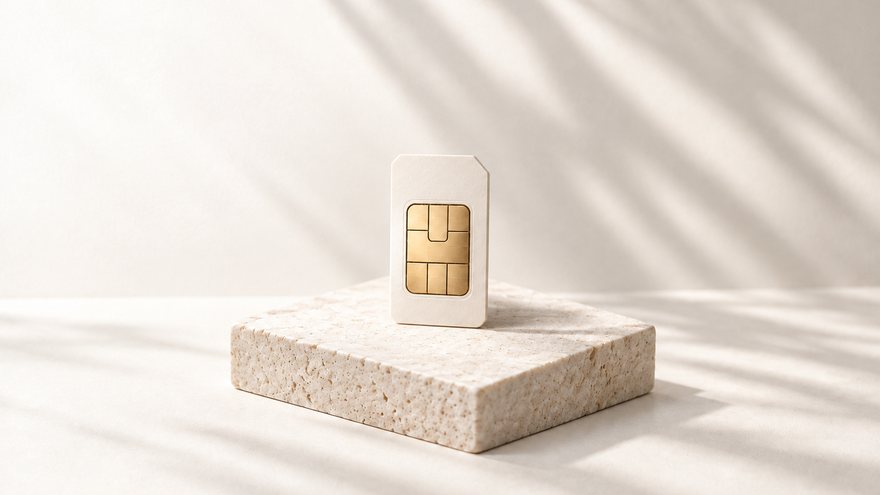
An eSIM is a digital SIM built into a device that lets you activate a mobile phone plan without inserting a physical SIM card. Depending on the device and carrier, it can also support two mobile lines.
eSIM at a Glance
| Feature | eSIM |
|---|---|
| Full meaning | Embedded SIM |
| Physical card required | No |
| Activation | Usually through a QR code, carrier app, device transfer or carrier activation |
| Main purpose | Connect a phone, tablet, smartwatch or other device to a mobile network |
| Can it support multiple plans? | Often, depending on the device and carrier |
| Does it require carrier support? | Yes |
| Does it automatically improve signal? | No |
How Does an eSIM Work?
An eSIM uses a secure embedded component called an eUICC. The eUICC stores one or more mobile network profiles. These profiles contain the information needed to authenticate the device with a carrier's network. The carrier can download or manage a profile remotely.
The usual activation process is:
- Check that the phone supports eSIM.
- Confirm that the carrier supports eSIM for that device.
- Choose an eSIM mobile plan.
- Activate the plan with a QR code, carrier app, carrier activation service or device-to-device transfer.
- Choose which line handles calls, texts and mobile data if you use more than one SIM.
An eSIM is not the same as an eSIM plan. The eSIM is the built-in technology. The carrier plan provides the mobile service.
What Are the Benefits of an eSIM?
No Physical SIM Card Is Needed
You do not need to wait for a plastic SIM card, carry a spare card or use a SIM tray. You can activate service and change plans digitally.
It Can Support Two Mobile Lines
Many compatible phones can use an eSIM alongside a physical SIM. Some phones also support multiple eSIM profiles. This can separate personal and business numbers or combine a regular phone plan with a travel data plan. The number of active lines depends on the phone and carrier.
It Is Useful When Travelling
A compatible, unlocked phone can often use an international eSIM data plan without removing the primary SIM. You can use a local or travel provider for mobile data while keeping your regular number available. Your carrier's roaming and dual-SIM settings still apply.
It Is Harder to Remove From a Stolen Phone
A physical SIM can be removed from a lost or stolen phone. An eSIM is built into the device, so it cannot be taken out in the same way. Apple identifies this as a security advantage, but account security, device protection and carrier controls still matter.
It Supports Smaller Connected Devices
The eSIM standard supports devices such as smartwatches, tablets, fitness trackers and other connected products that may not have room for a removable SIM tray.
What Are the Disadvantages of an eSIM?
Your Phone and Carrier Must Support It
An eSIM works only when both the device and mobile provider support compatible eSIM activation. Support can vary by country, device model, carrier and plan.
Moving Service May Require Extra Steps
With a physical SIM, you can often move the card directly to another compatible phone. With an eSIM, you may need to transfer the profile, scan a new QR code, use a carrier app or contact the carrier.
A Locked Phone May Restrict Other eSIM Providers
An eSIM does not bypass a carrier lock. If the phone is locked to one network, it may prevent you from activating an eSIM from another provider.
Troubleshooting Can Depend on the Carrier
If activation fails, the cause may be the QR code, account, device compatibility, carrier provisioning or network settings. The carrier may need to reissue or reset the eSIM profile.
eSIM vs. Physical SIM
| Difference | eSIM | Physical SIM |
|---|---|---|
| Form | Embedded digital SIM technology | Removable plastic card |
| Installation | Download or transfer a carrier profile | Insert the card into the SIM tray |
| Switching phones | Requires digital transfer or reactivation | Move the card to another compatible phone |
| Travel use | Add a travel plan without removing the main SIM | Swap cards or use a dual-SIM phone |
| Risk of loss | Cannot be physically misplaced as a card | Can be lost or damaged |
| Carrier compatibility | Requires eSIM support | Works wherever the physical SIM format is supported |
Both types perform the same essential job: they authenticate a mobile subscription on a carrier's network. The difference is how the subscriber profile is stored and installed.
Is an eSIM Better Than a Physical SIM?
An eSIM is usually better for digital activation, travel, dual-line use and avoiding physical SIM cards. A physical SIM may be more convenient when you often move service between phones or use a carrier that does not support eSIM.
Choose an eSIM if you:
- Want to activate a plan without visiting a store or waiting for delivery
- Travel internationally and want to add a temporary data plan
- Need personal and business numbers on one phone
- Prefer a phone without a removable SIM card
- Use a compatible smartwatch, tablet or connected device
Choose a physical SIM if you:
- Regularly move your service between different phones
- Use a carrier or device that does not support eSIM
- Want the simplest replacement method after changing phones
Does an eSIM Improve Mobile Signal or Speed?
No. An eSIM does not inherently make mobile service faster or provide stronger reception. It changes how the carrier subscription is installed on the device. Coverage, network technology, phone hardware, plan restrictions and local signal conditions determine connection quality.
Bottom Line
An eSIM is a built-in replacement for a physical SIM card. It lets a supported device download a carrier plan digitally. Before activating one, check device compatibility, carrier support and whether the phone is unlocked.